
You are my lamp, O Lord; the Lord turns my darkness
into light.

With your help I can advance against a troop;
with my God I can scale a wall.
2 Samuel 22:29,30


If you falter in times of trouble, how small is your strength!
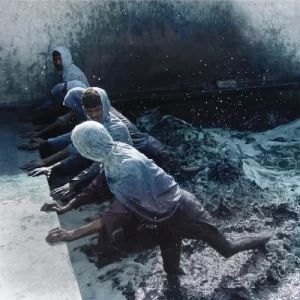
Rescue those being led away to death; hold back those staggering
toward slaughter.
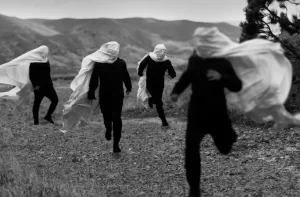
If you say, “But we knew nothing about this,” does not he who weighs
the heart perceive it?

Does not he who guards your life know it? Will he not repay each
person according to what he has done?
Proverbs 24: 10-12

Do not withhold your mercy from me, O Lord, may your love and your truth always protect me.
For troubles without number surround me; my sins have overtaken me, and I cannot see.
They are more than the hairs of my head, and my heart fails within me. Be pleased, O Lord,
to save; O Lord, come quickly to help me.

May all who seek to take my life be put to shame and confusion; may all who desire my
ruin be turned back in disgrace. May those who say to me, “Aha! Aha!” be appalled at
their own shame.
Psalm 40: 11-15

A voice of one calling: “In the desert prepare
the way for the Lord; make straight in the wilderness
a highway for our God.

Every valley shall be raised up, every mountain and hill
made low; the rough ground shall become level, the rugged
places a plain. And the glory of the Lord will be revealed,
and all mankind together will see it. For the mouth of the
Lord has spoken.”
Isaiah 40:3-5

The man without the Spirit does not accept the things that come
from the Spirit of God, for they are foolishness to him, and he cannot
understand them, because they are spiritually discerned.
The spiritual man makes judgments about all things, but he himself
is not subject to any man’s judgment:

“For who has known the mind of the Lord that he may instruct him?”
1 Corinthians 2:14-16a
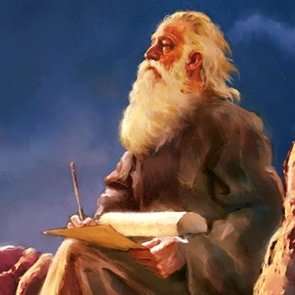
We do, however, speak a message of wisdom among the mature,

but not the wisdom of this age or of the rulers of this age,
who are coming to nothing. No, we speak of God’s secret wisdom,
a wisdom that has been hidden and that God destined for
our glory before time began. None of the rulers of this age
understood it, for if they had, they would not have crucified
the Lord of glory.

However, as it is written: “No eye has seen, no ear has heard,
no mind has conceived what God has prepared for those
who love him”—but God has revealed it to us by his Spirit. The Spirit searches
all things, even the deep things of God.
1 Corinthians 2:6-10

There was a man who was sent from God; his name was John. He came as a witness to testify
concerning that light, so that through him all might believe. He himself was not
the light; he came only as a witness to the light.
The true light that gives light to every man was coming into the world. He was in
the world, and though the world was made through him, the world did not recognize
him. He came to that which was his own, but his own did not receive him.

Yet to
all who received him, to those who believed in his name, he gave the right to
become children of God— children born not of natural descent, nor of human decision
or a husband’s will, but born of God.
John 1:6-13
And ye shall know the truth, and the truth shall make you free.
John 8:32

Plato… compares men who have never tried to face the truth to prisoners
in a deep underground cavern, who have been so chained… that they cannot
turn their heads. In front of them is the rocky wall of their prison-house.
Behind them and above them is a causeway , on which fires are burning, and
along this causeway pass wayfarers singing and conversing and bearing burdens,
whose shadows are thrown by the firelight on the cavern wall, and whose voices
are reflected back from it.
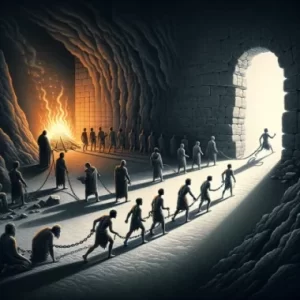
The imprisoned denizens of the dark cave, seeing
only these flickering shadows, take them for substances and realities; and
hearing only these vague echoes, take them for songs and voices….

“Imprisoned in self-chosen darkness, steeped in emptinesses, how few among
living men even care for that wisdom which consists in seeing the things that
are, and seeing them as they are!

Let a man but once catch a glimpse of the
true light and he learns utterly to despise the dim rush-light of this world’s
tinselled stage. Let one ray out of eternity shine down upon him, and for him
the world and the things of the world shrivel into insignificance.”
From Streams In The Desert Volume 2 August 23rd by Mrs.Charles E. Cowman